Posts

The realities of WASH in Africa

Image
  Following on from my last blog, where I mentioned the dichotomy between reports and realities of the quality of water and sanitation, this blog will be looking at the realities on the ground; faecal contamination of water, differentiation in supply and data inadequacies. Only 8 years until the Sustainable Development Goals (SDGs) are due to be achieved, and there is still major progress to be made. Especially in terms of water and sanitation, addressed by SDG6 .  In Africa in 2020 , only 39% of people used safely managed drinking water and 27% used safely managed sanitation. Therefore, in order to meet the SDGs by 2030, there needs to be 12 times increase in the rate of progress on safely managed drinking water and 20 times increase for safely managed sanitation! Africa, particularly Sub-Sahara Africa, needs to be at the forefront of improving water and sanitation systems, as these regions currently face the least delivery, shown by Figure 1.   Figure 1: Percenta...
Why write about water and sanitation in Africa?

Image
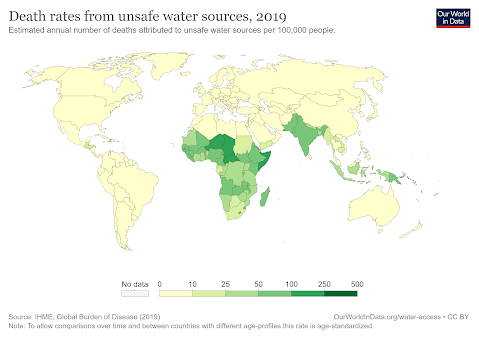
  Did you know that every day nearly 1000 children die due to preventable water and sanitation related diarrheal diseases ? Or that 2 in 5 people don’t have access to a basic hand washing facility (with soap and water)? Welcome to the WASH web, where over the following weeks I will be exploring some of the key issues related to water and sanitation in Africa. Including access to ‘improved’ water, toilets and handwashing and women and water, sanitation and hygiene (WASH). Globally there is an unequal distribution in the deaths attributed to unsafe water. Figure 1 shows that Sub-Saharan Africa has much higher death rates than other regions – with some countries, such as Chad having over 100 deaths per 100,000 people. Therefore, improving water and sanitation in Africa is critical if SDG 6 (clean water and sanitation) is to be met by 2030.           Figure 1: Map to show global distribution in death rates from unsafe water sources, 2019   ...